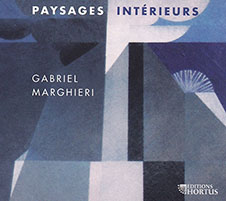
« Paysages intérieurs », paru aux Editions Hortus, offre des extraits de sept suites improvisées à l’orgue, comme autant de chambres secrètes ouvertes sur un monde intérieur, façonnées sur le grand orgue Merklin–Kuhn /Michel Jurine de la basilique Saint Bonaventure de Lyon dont Gabriel Marghieri sculpte les timbres avec une sensualité picturale. Chaque suite devient un territoire émotionnel, tantôt murmure suspendu, tantôt élan incandescent, où l’improvisation, jamais abandonnée au hasard, se déploie en architectures souples, en respirations profondes, en couleurs ciselées qui révèlent une écoute absolue de l’espace. Né en 1964, Gabriel Marghieri a étudié l’orgue auprès d’Henri Carol, René Saorgin, Marie-Claire Alain aux Conservatoires de Nice et Rueil-Malmaison puis de Michel Chapuis au Conservatoire National Supérieur de Musique et de Danse de Paris. Il a obtenu les Premiers Prix d’orgue, analyse et harmonie du C.N.S.M. de Paris, et le Premier Prix à l’unanimité d’Improvisation du C.N.S.M. de Lyon. Il a remporté les Grands Prix Internationaux d’Interprétation de Bordeaux (1988) et Saint-Albans, (1993) et d’improvisation au Concours International d’Orgue de Chartres (1996). Titulaire du Certificat d’Aptitude d’orgue, il est professeur d’orgue et d’harmonie au Conservatoire de Levallois-Perret et professeur-assistant pour l’improvisation et l’harmonie au clavier au Conservatoire National Supérieur de Lyon. Après avoir été organiste de diverses églises, dont Saint Paul-Saint Louis du Marais à Paris, il a été nommé titulaire du Sanctuaire Saint-Bonaventure de Lyon et de la Basilique du Sacré-Cœur de Montmartre à Paris. Héritier des grandes écoles françaises d’improvisation, Gabriel Marghieri affirme ici une voix singulière, à la fois rigoureuse, visionnaire et habitée, capable de transformer l’instant en matière poétique. Il signe avec cet album un véritable journal sonore, où l’orgue devient un miroir de lumière, de doute, de souffle et de plénitude ; un voyage intérieur dont on ressort ému.
Jean-Jacques Millo “Paysages intérieurs,” published by Editions Hortus, features excerpts from seven improvised organ suites—like so many secret chambers opening onto an inner world—crafted on the grand Merklin–Kuhn / Michel Jurine organ at the Basilica of Saint Bonaventure in Lyon, whose timbres Gabriel Marghieri sculpts with a painterly sensuality. Each suite becomes an emotional landscape, at times a suspended whisper, at others an incandescent surge, where improvisation—never left to chance—unfolds into fluid structures, deep breaths, and finely chiseled timbres that reveal an absolute attunement to the space. Born in 1964, Gabriel Marghieri studied the organ with Henri Carol, René Saorgin, and Marie-Claire Alain at the conservatories of Nice and Rueil-Malmaison, then with Michel Chapuis at the Paris Conservatoire National Supérieur de Musique et de Danse. He won First Prizes in organ, music theory, and harmony at the C.N.S.M. in Paris, and a unanimous First Prize in improvisation at the C.N.S.M. in Lyon. He won the Grand Prix International d’Interprétation in Bordeaux (1988) and Saint-Albans (1993), and the Grand Prix for improvisation at the International Organ Competition in Chartres (1996). Holder of the Certificate of Proficiency in Organ, he is a professor of organ and harmony at the Conservatoire de Levallois-Perret and an assistant professor of improvisation and harmony on the keyboard at the Conservatoire National Supérieur de Lyon. After serving as organist at various churches, including Saint Paul-Saint Louis du Marais in Paris, he was appointed titular organist of the Saint-Bonaventure Sanctuary in Lyon and the Basilica of the Sacred Heart in Montmartre, Paris. As an heir to the great French schools of improvisation, Gabriel Marghieri asserts a singular voice here—at once rigorous, visionary, and deeply felt—capable of transforming the moment into poetic matter. With this album, he creates a true sonic diary, where the organ becomes a mirror of light, doubt, breath, and fullness; an inner journey from which one emerges deeply moved.
Translation Lawrence Schulman |