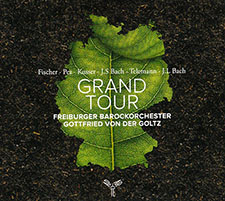
Le disque, « Grand Tour » chez Aparté, trace un itinéraire à la fois concret et imaginaire à travers l’Allemagne du XVIIIe siècle, porté par le Freiburger Barockorchester sous la direction souple et incisive de Gottfried von der Goltz. La dramaturgie du programme repose sur un maillage d’écoles et de styles qui se répondent, sans jamais tomber dans l’anthologie gratuite. Dès l’ouverture, l’élégance française irrigue la « Suite en ré mineur » de Johann Caspar Ferdinand Fischer, tirée du « Journal du Printemps ». Le relais est pris par Johann Christoph Pez, maître de chapelle à Stuttgart, avec « Concerto Pastorale » qui ajoute à la grammaire française des syncopes italiennes et une énergie de danse plus terrienne. Johann Sigismund Kusser est également présent pour revenir au geste français par un détour germanique. Son « Ouverture en sol mineur » (Apollon enjoué) avec des danses à la carrure noble, frôle parfois l’emblématique. Le cœur du voyage se resserre autour de la lignée bachienne. Johann Ludwig Bach, cousin de Jean Sébastien et figure de Meiningen, impose une noblesse discrète, avec des procédés imitatifs. Ici, l’écriture gagne en relief par la variété des attaques et une dynamique au cordeau, donnant à l’architecture sa dimension expressive. Quand J. S. Bach paraît avec son « Concerto Brandebourgeois N°2 » BWV 1047, le paysage se densifie et le contrepoint respire sans jamais céder à l’emphase. Dans ce parcours, Georg Philipp Telemann et son « Concerto pour flûte et violon » en mi mineur TWV 52 occupe le rôle du passeur cosmopolite. Sa plume y brille par une adresse rhétorique. Au bout du chemin, le disque tient sa promesse en montrant comment Fischer, Pez, Telemann, Johann Ludwig Bach, J. S. Bach et Kusser dessinent la carte sensible d’une Europe musicale en mouvement. C’est la réussite majeure de cette parution.
Jean-Jacques Millo The album, “Grand Tour,” released by Aparté, traces a concrete yet imaginary itinerary through 18th-century Germany, performed by the Freiburger Barockorchester under the supple and incisive direction of Gottfried von der Goltz. The dramaturgy of the program is based on a network of schools and styles that respond to each other, without ever falling into gratuitous anthology. From the opening bars, French elegance permeates Johann Caspar Ferdinand Fischer’s “Suite in D minor,” taken from the “Journal du Printemps.” Johann Christoph Pez, Kapellmeister in Stuttgart, takes over with “Concerto Pastorale,” which adds Italian syncopation and a more earthy dance energy to the French grammar. Johann Sigismund Kusser is also present, returning to the French style via a Germanic detour. His “Overture in G minor” (Apollon enjoué), with its noble dances, sometimes borders on the emblematic. The heart of the journey centers on the Bach lineage. Johann Ludwig Bach, cousin of Johann Sebastian and a figure in Meiningen, imposes a discreet nobility with imitative techniques. Here, the writing gains depth through the variety of attacks and precise dynamics, giving the architecture its expressive dimension. When J. S. Bach appears with his “Brandenburg Concerto No. 2” BWV 1047, the landscape becomes denser and the counterpoint breathes without ever giving way to bombast. In this journey, Georg Philipp Telemann and his “Concerto for Flute and Violin” in E minor TWV 52 take on the role of cosmopolitan facilitators. His pen shines with rhetorical skill. At the end of the journey, the disc keeps its promise by showing how Fischer, Pez, Telemann, Johann Ludwig Bach, J. S. Bach, and Kusser draw the sensitive map of a musical Europe in motion. This is the major achievement of this release.
Translation Lawrence Schulman |