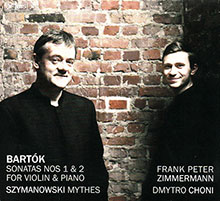
Le label BIS propose ici une rencontre fascinante entre deux figures majeures du début du XXᵉ siècle : Béla Bartók (1881-1945) et Karol Szymanowski (1882-1937), interprétés par Frank Peter Zimmermann (violon) et Dmytro Choni (piano). Trois œuvres emblématiques y sont réunies : les « Sonates pour violon et piano n°1 et n°2 » du hongrois, et le triptyque « Mythes », op.30 du polonais. Commandée par la violoniste Jelly d’Arányi, la « sonate N°1 » (1921) est l’une des premières grandes œuvres de Bartók à intégrer pleinement les influences de la musique populaire hongroise dans une écriture moderniste. Plus concise et épurée, la seconde sonate (1922) se déploie en deux mouvements seulement. Bartók y affine son langage, privilégiant une atmosphère méditative et une écriture plus transparente. L’œuvre illustre la transition vers une esthétique où la densité contrapuntique et la couleur modale s’allient à une expressivité presque austère. Écrits pour le violoniste Pawel Kochański, les trois pièces qui composent « Mythes » (La Fontaine d’Aréthuse, Narcisse, Dryades et Pan), datant de 1915, incarnent l’apogée du style impressionniste polonais. Szymanowski, marqué par ses voyages en Italie et en Grèce, puise dans la mythologie antique pour créer une musique de couleur et de timbre, proche de Debussy et Ravel, mais avec une intensité émotionnelle propre. Les deux compositeurs participent à la redéfinition du rôle du violon et du piano dans la musique de chambre, en élargissant les possibilités expressives et en repensant les rapports entre folklore, mythe et modernité. Finalement, ce SACD met en lumière la complémentarité de deux modernismes européens, l’un tendu vers la terre et la pulsation populaire (Bartók), l’autre vers la lumière et la mythologie (Szymanowski). Frank Peter Zimmermann et Dmytro Choni offrent une lecture de ces partitions d’une grande clarté, où la virtuosité se met au service de la densité historique et poétique des œuvres.
Jean-Jacques Millo The BIS label presents a fascinating encounter between two major figures of the early 20th century: Béla Bartók (1881-1945) and Karol Szymanowski (1882-1937), performed by Frank Peter Zimmermann (violin) and Dmytro Choni (piano). Three iconic works are brought together here: the Hungarian composer’s “Sonatas for Violin and Piano Nos. 1 and 2” and the Polish composer’s triptych “Myths,” Op. 30. Commissioned by violinist Jelly d’Arányi, Sonata No. 1 (1921) is one of Bartók’s first major works to fully integrate the influences of Hungarian folk music into a modernist style of writing. More concise and refined, the second sonata (1922) unfolds in only two movements. Bartók refines his language here, favoring a meditative atmosphere and a more transparent style of writing. The work illustrates the transition to an aesthetic in which contrapuntal density and modal color combine with an almost austere expressiveness. Written for the violinist Pawel Kochański, the three pieces that make up “Myths” (The Fountain of Arethusa, Narcissus, Dryads and Pan), dating from 1915, embody the apogee of the Polish impressionist style. Szymanowski, influenced by his travels in Italy and Greece, drew on ancient mythology to create music rich in color and timbre, close to Debussy and Ravel, but with its own emotional intensity. Both composers contributed to redefining the role of the violin and piano in chamber music, broadening their expressive possibilities and rethinking the relationship between folklore, myth, and modernity. Ultimately, this SACD highlights the complementarity of two European modernisms, one oriented toward the earth and popular rhythms (Bartók), the other toward light and mythology (Szymanowski). Frank Peter Zimmermann and Dmytro Choni offer a highly lucid interpretation of these scores, in which virtuosity is placed at the service of the historical and poetic density of the works.
Translation Lawrence Schulman |