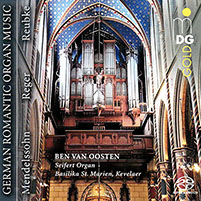
Le romantisme organistique allemand demeure paradoxalement moins fréquent au disque que son pendant français. Si l’on connaît les grandes fresques de Franck, Widor ou Vierne, l’univers de Félix Mendelssohn Bartholdy (1809-1847), Julius Reubke (1834-1858) et Max Reger (1873-1916) reste souvent perçu comme austère, réservé aux spécialistes. Ce SACD, confié à l’organiste Ben van Oosten, né en 1955 et formé au Sweelinck Conservatorium d’Amsterdam puis à Paris auprès d’André Isoir et Daniel Roth, vient combler une lacune en proposant une lecture cohérente de ce répertoire, en le situant dans une perspective historique et esthétique. Mendelssohn, héritier de Bach et figure centrale du renouveau religieux protestant, compose ses « Sonates pour orgue » comme des méditations chorales, où la rigueur contrapuntique se marie à une ferveur intime. Reubke, disciple de Liszt, transpose à l’orgue la dramaturgie pianistique et orchestrale, donnant naissance à la monumentale « Sonate sur le 94e Psaume », véritable poème symphonique. Quant à Reger, il incarne l’excès et la densité du tournant fin-de-siècle où ses fantaisies chorales sont des cathédrales sonores, où la polyphonie se déploie jusqu’à l’épuisement. Ben Van Oosten (jouant sur l’orgue Seifert de la Basilique St. Marien de Kevelaer) impose une vision architecturale dans une construction en arcs narratifs, donnant à chaque œuvre une cohérence organique. Son jeu conjugue rigueur germanique et souffle symphonique, héritage de ses affinités françaises. En complément nous découvrirons également des pièces de Otto Türke (1832-1897), Johann Julius Schneider (1805-1885) et Sigfrid Karg-Elert (1877-1933). Bref, un SACD indispensable pour tous les amoureux du Roi des instruments.
Jean-Jacques Millo Paradoxically, German organ romanticism remains less common on record than its French counterpart. While we are familiar with the great works of Franck, Widor, and Vierne, the world of Felix Mendelssohn Bartholdy (1809-1847), Julius Reubke (1834-1858), and Max Reger (1873-1916) is often perceived as austere, reserved for specialists. This SACD, entrusted to organist Ben van Oosten, born in 1955 and trained at the Sweelinck Conservatorium in Amsterdam and then in Paris with André Isoir and Daniel Roth, fills a gap by offering a coherent reading of this repertoire, placing it in a historical and aesthetic perspective. Mendelssohn, heir to Bach and a central figure in the Protestant religious revival, composed his “Organ Sonatas” as choral meditations, where contrapuntal rigor is combined with intimate fervor. Reubke, a disciple of Liszt, transposed the dramaturgy of piano and orchestra to the organ, giving rise to the monumental “Sonata on Psalm 94,” a veritable symphonic poem. As for Reger, he embodies the excess and density of the fin-de-siècle period, where his choral fantasies are cathedrals of sound, and polyphony unfolds to the point of exhaustion. Ben Van Oosten (playing on the Seifert organ of St. Mary’s Basilica in Kevelaer) imposes an architectural vision in a construction of narrative arcs, giving each work an organic coherence. His playing combines Germanic rigor with symphonic inspiration, a legacy of his French affinities. In addition, we will also discover pieces by Otto Türke (1832-1897), Johann Julius Schneider (1805-1885), and Sigfrid Karg-Elert (1877-1933). In short, this is an essential SACD for all lovers of the King of Instruments.
Translation Lawrence Schulman |